Inuktitut Medical & Legal Translation Curriculum
For Nunavut Arctic College
This project is about building a medical and legal translation program from scratch for Nunavut’s indigenous community—where no prior curriculum existed, no physical teaching aids were available, and community trust had to come before content.
Why This Project
Nunavut is the only jurisdiction in Canada where the majority of the population speaks a language that is not English or French—approximately 75% of Inuit in Nunavut speak Inuktut as their first language. Yet the territory‘s healthcare and legal systems operate primarily in English, creating a persistent gap between services provided and the language spoken by the people who need them.
The challenge is not merely one of convenience but of rights and safety. Nunavut’s Official Languages Act and Inuit Language Protection Act guarantee residents the right to receive services in Inuktitut and Inuinnaqtun. In practice, this creates a constant demand for qualified interpreters—a demand that far exceeds the available supply. As of 2024, there were only three certified legal interpreters in Nunavut, and they were aging. Pharmacists reported struggling to formally translate written materials into Inuit languages due to concerns for patient safety.
Despite this acute need, the interpreter/translator training program at Nunavut Arctic College was limited in its capacity to produce enough graduates to meet the demand. The existing program was delivered primarily in person, which restricted access for students across the territory’s 25 remote communities, many of which are not connected by road.
The project was driven by a simple but urgent question: how do you scale training for a profession that is critically needed, in a place where access is severely limited, without compromising the quality of the skills being taught?
The Complexity
No existing curriculum
The program had instructional content, but it was not designed for online delivery. I needed to transform existing materials into a structured, interactive eLearning experience on Brightspace LMS.
No physical teaching aids
Students in the Arctic had no access to anatomical models, cadavers, or hands-on teaching tools to learn medical terminology and body structures.
No courtroom access
Legal interpretation is best learned through observing real proceedings—but students in the Arctic had no way to access courtrooms for observation or practice.
Complex terminology
Medical and legal terms in English and French have no direct equivalents in Inuktitut. Translation required deep engagement with terminology development, idioms, and cultural relevance.
Cultural trust
The community has historical mistrust of mainstream institutions. I could not simply “walk in and start designing.” Trust had to be built before any real work could begin.
Remote delivery
The program needed to serve students across 25 communities with limited connectivity, requiring careful consideration of bandwidth constraints and offline access.

“The problem wasn‘t a lack of willing learners—it was a lack of everything else. No curriculum. No teaching aids. No courtroom access. I built the program from scratch, replacing what wasn’t there with what could be.”
What I Did
Tech stack: Brightspace LMS, HTML/CSS/JS, H5P, ElevenLabs, Adobe Suite

Built a fully functional online program on Brightspace LMS
Transformed instructional storyboards into structured eLearning modules organized by course and module.

Replaced physical models with visual learning tools
To replace physical teaching aids, I designed interactive anatomical diagrams in H5P that allowed students to explore the human body by clicking on different parts to reveal the English and Inuktitut names and definitions.
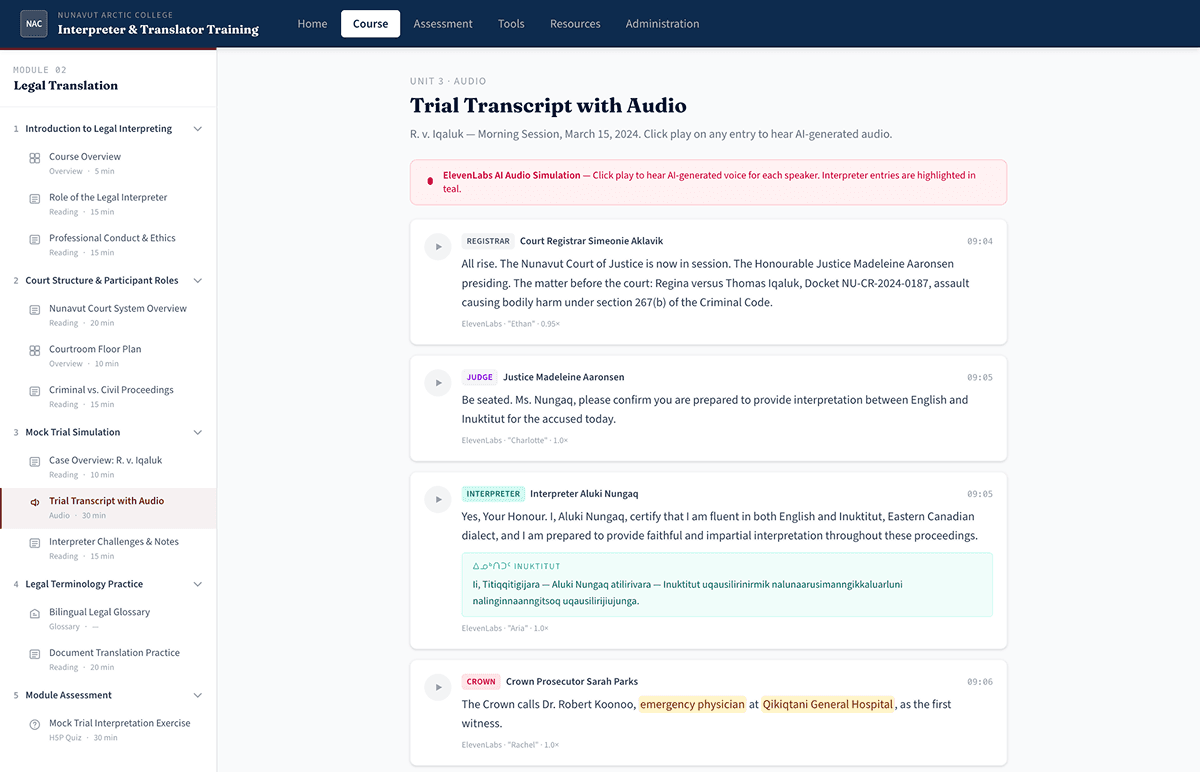
Replaced courtroom observation with AI-generated audio
Researched and introduced ElevenLabs to generate simulated courtroom audio for Legal Interpreting modules.

Built bilingual glossaries
Created bilingual English–Inuktitut glossaries for both the medical and legal interpreting courses—covering anatomical terminology, body systems, and diseases for the medical module, and court procedures, criminal offenses, and trial roles for the legal module.
The glossaries gave students a searchable reference they could return to throughout the course, helping them retain specialized vocabulary across both disciplines.
Impact
The program was deployed to over 1,500 students across 25 remote Arctic communities, with graduates consistently securing positions before completing their studies. Post-launch outcomes showed that translator candidate pass rates significantly exceeded previous cohorts, and community feedback confirmed improved access to healthcare and legal services for Inuktitut-speaking residents—closing a gap that had persisted for years. The program was renewed for Phases 2 and 3, validating both the effectiveness of the online delivery model and the quality of the learning experience.